



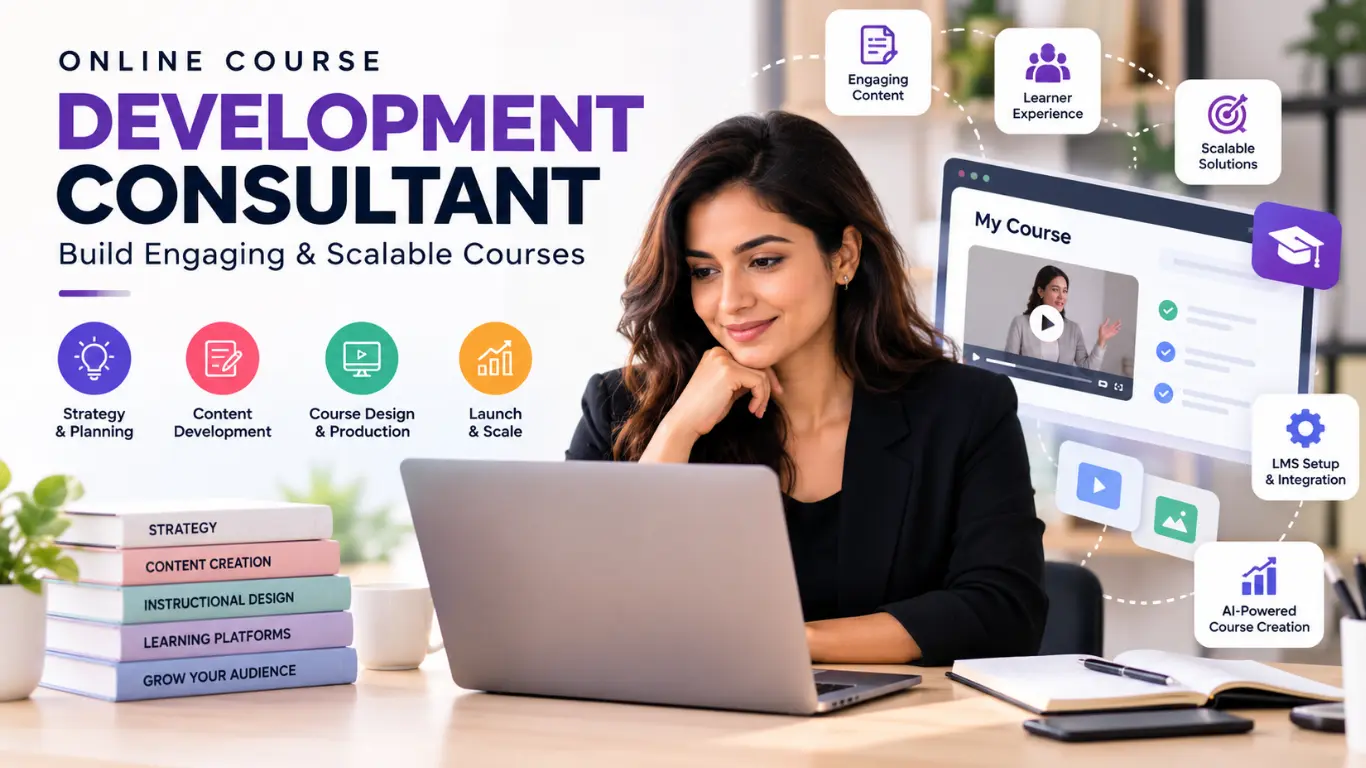
Creating an online course is more than recording videos and uploading them to a learning platform. A successful course needs a clear learning strategy, engaging content, thoughtful instructional design, the right technology, and a strong understanding of the learner. An online course development consultant helps businesses, educators, experts, and organizations turn knowledge and expertise into structured, valuable, and scalable learning experiences.
With experience across media production, online education, content strategy, and AI, Vani Aggarwal helps organizations approach course development as both a learning and content strategy. Her work focuses on creating educational experiences that are practical, engaging, and aligned with real business or learner needs.
What Does an Online Course Development Consultant Do?
An online course development consultant helps guide the complete process of transforming knowledge into an effective digital learning program. This can include everything from defining the target audience and learning objectives to planning content, designing modules, developing multimedia assets, and improving the learner experience.
A consultant can help answer important questions such as:
- Who is the course designed for?
- What should learners know or be able to do after completing it?
- How should the information be structured?
- Which topics require video, visuals, exercises, or demonstrations?
- How can learners stay engaged throughout the course?
- Which learning platform and technology are appropriate?
- How can the course be updated and scaled over time?
This strategic approach helps prevent a common problem: creating large amounts of content without a clear learning journey.
How to Build Courses Around Learner Needs
Effective online learning starts with the learner. Before developing lessons, it is important to understand the audience’s knowledge level, goals, challenges, and preferred learning context.
For example, an online course for marketing professionals may need practical case studies, templates, demonstrations, and real-world exercises rather than long theoretical lectures. A corporate training program may require measurable learning objectives, assessments, internal examples, and a structure that works for busy employees.
An experienced online course development consultant can help translate these requirements into a learning architecture that is easier to navigate and more useful for the intended audience.
How to move from Expertise to Structured Learning
Subject-matter experts often have extensive knowledge but may find it difficult to organize that knowledge into a course. They may know what they want to teach but not necessarily how to sequence it for learners.
Course development involves turning expertise into a logical progression:
Knowledge → Learning Objectives → Course Structure → Lessons → Activities → Assessment → Outcomes
Each module should have a purpose. Instead of simply presenting information, the course should help learners understand concepts, apply knowledge, practice skills, and evaluate their progress.
This is where strategic course development can make a significant difference.
Tips for Creating Engaging Online Course Content
Learner engagement depends on more than visual design. Strong online courses combine different types of content to create variety and encourage active participation.
Depending on the subject, a course may include:
- Expert-led video lessons
- Screen recordings and demonstrations
- Interactive exercises
- Downloadable resources
- Quizzes and assessments
- Real-world case studies
- Practical assignments
- Templates and checklists
- Reflection activities
- Discussion or community elements
Vani Aggarwal brings a production and storytelling perspective to educational content, helping organizations think beyond conventional lecture-based formats. Video, storytelling, visuals, and practical examples can be strategically integrated where they genuinely improve understanding.
How to Use AI in Online Course Development
AI is increasingly becoming part of the course creation workflow. When used thoughtfully, AI can support research, content organization, lesson planning, idea generation, assessment creation, personalization, and workflow automation.
However, AI should support the learning strategy rather than replace human expertise.
A strong online course development consultant can help organizations identify where AI can reduce repetitive work while maintaining accuracy, originality, human judgment, and educational quality. This is particularly useful when developing large learning libraries or regularly updating existing programs.
The goal should not simply be to create more content faster. The goal is to create better learning experiences more efficiently.
How to designing Scalable Learning Programs
Businesses often begin with one course and eventually need a complete learning ecosystem. A scalable approach considers future expansion from the beginning.
For example, one core course can potentially evolve into:
- Beginner and advanced programs
- Certification pathways
- Corporate training modules
- Short-form microlearning
- Workshops and webinars
- Learning resources and templates
- Subscription-based education
- Internal employee training
This approach allows organizations to build reusable content systems rather than treating every course as a completely separate project.
How to Choose the Right Technology
The learning platform is another important part of course development. The right solution depends on factors such as audience size, content type, assessment requirements, integrations, analytics, branding, and budget.
An online course development consultant can help evaluate these requirements before a platform is selected. This can reduce the risk of choosing technology based solely on features without considering the actual learning experience.
The technology should support the course—not become the focus of it.
Why Work With Vani Aggarwal?
Vani Aggarwal combines experience in filmmaking, media production, online education, content strategy, and AI to approach course development from multiple perspectives. This combination can be valuable for organizations that want their educational content to be informative while also being engaging and professionally produced.
Her approach focuses on connecting strategy, storytelling, technology, and learning design rather than treating course creation as simply a video-production task.
For businesses, educators, and experts looking to transform their knowledge into structured digital learning, working with an online course development consultant can provide a clearer roadmap from initial concept to finished learning experience.
How to build Courses That Deliver Real Learning Value
A successful online course should do more than collect information in one place. It should guide learners toward a meaningful outcome.
From defining learning objectives and organizing expert knowledge to producing engaging content and integrating AI-enabled workflows, every stage contributes to the final learner experience.
With the right strategy and development process, organizations can create online courses that are engaging, practical, credible, and scalable.
If you are planning to transform your expertise, training material, or business knowledge into an online learning program, Vani Aggarwal can help bring together course strategy, content development, storytelling, production, and AI to create a purposeful digital learning experience.





Share your thoughts